
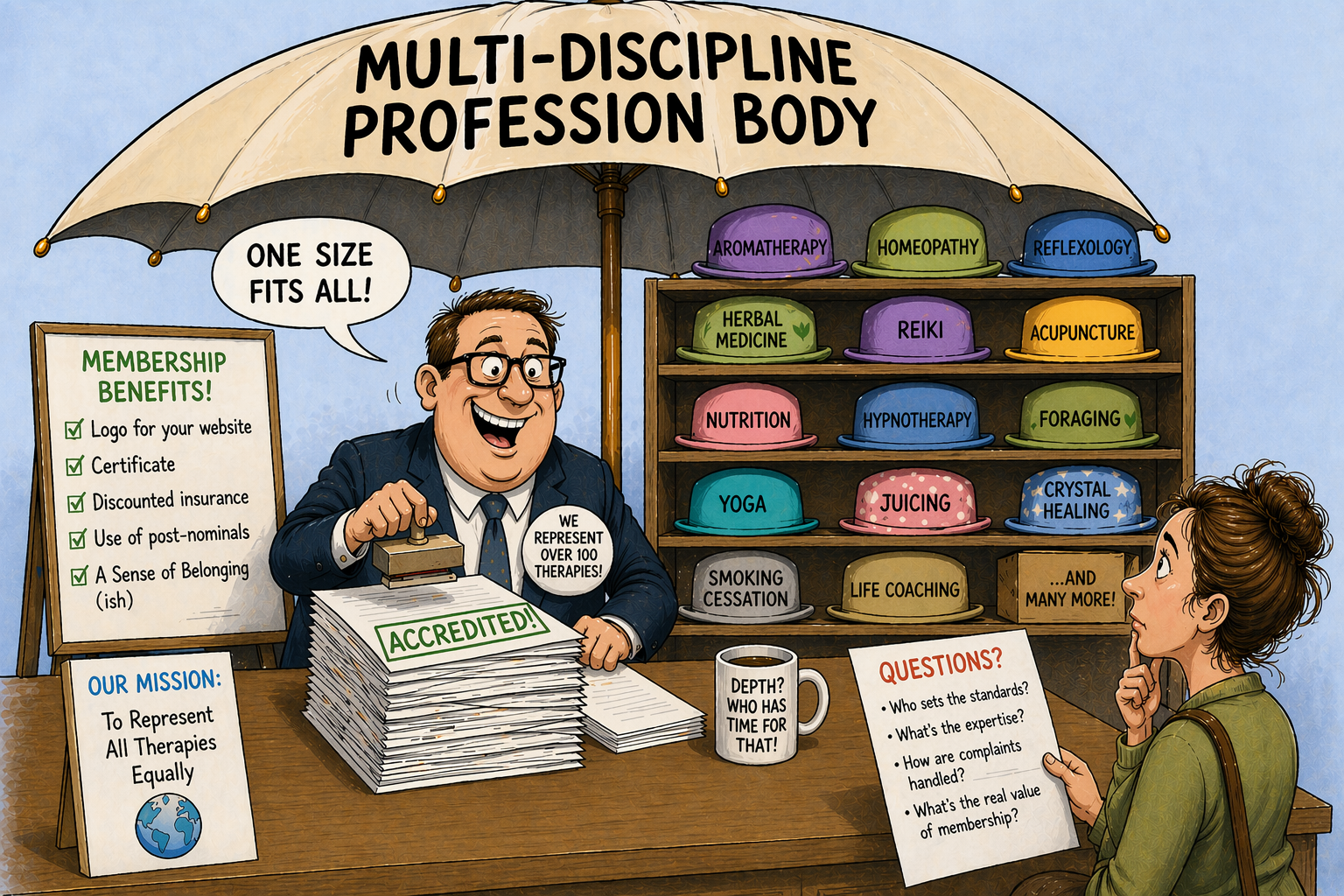
At first glance, Multi-Discipline Profession Bodies may appear progressive and efficient. Yet increasingly, questions are being asked about whether multi-discipline associations genuinely advance professional standards or whether they primarily operate as fee-collection structures offering limited tangible benefit to practitioners.
Within the United Kingdom’s complementary medicine sector, profession bodies such as Homeopathy International (HINT) play a central role. They offer public, and parliamentary representation, a codes of ethics, complaints procedures, insurance signposting, continuing professional development (CPD) frameworks, and, crucially, a sense of identity and legitimacy. Traditionally, most profession associations have developed around a single discipline: homeopathy, osteopathy, nutritional therapy, reflexology, herbal medicine, and so forth. This model allows for the depth, specialist governance, and a coherent professional voice needed to support the profession and the practitioner.
Alongside these single-discipline bodies, however, a different model has emerged. Organisations which promote themselves as umbrella associations representing a vast array of modalities under one banner. They often offer practitioner memberships across dozens, sometimes hundreds, of therapies and claim to “accredit” training providers spanning the breadth of complementary health and beyond.
The Problem of Breadth Without Depth
Professional regulation, even when voluntary, relies upon detailed expertise across every aspect of each discipline. This depth and detail is impossible to achieve with tens or hundreds of therapies.
All bodies, whether for nutritional therapists, reflexologists or homeopaths to name a few, must categorically understand the specifics including case analysis, philosophy, clinical evidence, biochemistry, red flags, scope of practice, nuances of anatomy, contraindications; the list goes on and on. And this breakdown does not take into consideration the detailed knowledge needed that applies to specific, individual professions.
There is also another important aspect to this debate – professional bodies need to work efficiently, and in an informed manner. with a vast range of individuals and groups including colleges, parliamentarians, journalists, researchers, lawyers (who specialise) etc … and there simply are not enough hours in the day.
When a single organisation claims to represent dozens of distinct ‘modalities’ ranging from Aromatherapy to Smoking Cessation, Homeopathy to Juicing; serious questions arise:
- Who sets the standards for each discipline?
- What subject-matter expertise exists within governance?
- How are competency thresholds determined?
- How are complaints assessed fairly and accurately?
Depth of oversight is difficult to achieve across one discipline. Across a hundred or more, it becomes arguably unmanageable. The risk is that “representation” becomes little more than administrative processing of membership applications rather than robust professional stewardship.
The Illusion of Accreditation
Perhaps the most contentious issue concerns the use of the term “accreditation”. In mainstream professional contexts such as medicine, law, dentistry, psychology, accreditation is a rigorous, independent, often externally benchmarked process. It involves curriculum scrutiny, clinical hour verification, assessment validation, and ongoing quality assurance.
Within some multi-discipline associations, however, “accreditation” appears to function differently. Training providers may be listed as “approved” or “accredited” after processes that are not transparent, not externally benchmarked, and not clearly comparable to established professional standards.
The result is a dilution of language.
When every short course, online diploma, or weekend workshop can potentially receive an “accredited” badge, the word ceases to signal meaningful quality assurance. For practitioners who invest heavily in education (often at significant financial and personal cost) this is not a trivial matter. It risks equating comprehensive, multi-year training with minimal programmes of limited academic rigour.
Such levelling down does not strengthen complementary medicine; it undermines it.
Membership Without Meaning
Professional membership, ideally, should confer:
- A recognised professional identity
- Access to high-quality CPD
- A meaningful code of ethics
- A credible complaints procedure
- Advocacy at policy level
- Peer community and support
Where a body represents an extremely wide range of therapies, the question becomes: how tailored can these services truly be?
A generic code of ethics that attempts to cover all modalities may lack the specificity required for safe practice. A complaints process that does not differentiate between clinical complexities in different disciplines risks either superficiality or inconsistency. CPD offerings may become broad and unspecialised rather than discipline-specific and clinically robust.
Practitioners may find that beyond a certificate, a logo for their website, and perhaps access to discounted insurance, little substantive professional infrastructure is provided.
If membership amounts primarily to permission to use post-nominals and marketing badges, the value proposition becomes questionable.
The Commercial Incentive
It is reasonable to observe that the broader the eligibility criteria for membership, the larger the potential revenue pool. When nearly any modality can join, and nearly any training provider can be “accredited”, income scalability increases significantly.
This does not automatically imply wrongdoing. However, it does introduce a potential conflict between commercial expansion and professional integrity.
A highly selective association, with strict entry criteria, may grow more slowly but build stronger credibility. A broadly inclusive body may grow rapidly but risk weakening perceived standards.
Practitioners must ask themselves:
Is this organisation selective in the interests of the public and the profession or inclusive in the interests of subscription revenue?
Public Perception and Reputational Risk
The complementary medicine sector already faces scrutiny from regulators, sceptics, and policymakers. In such an environment, credibility is precious.
When umbrella organisations appear to grant membership and “accreditation” widely and with minimal visible scrutiny, the perception can be damaging, not only to those associations but to the entire sector.
Critics may point to the ease of obtaining membership as evidence that complementary medicine lacks coherent standards. Policymakers may hesitate to engage seriously with a profession whose representative bodies appear fragmented and inconsistent.
Ironically, the very organisations that claim to unite the sector may contribute to its perceived lack of cohesion and seriousness.
The Erosion of Professional Identity
Single-discipline bodies often play a critical role in shaping professional identity. They develop position papers, research summaries, educational benchmarks, and practitioner guidelines specific to their field. They advocate at government and governmental level for recognition in NHS settings and liaise with insurers.
In contrast, a multi-discipline body must spread its attention thinly. It cannot realistically produce detailed policy engagement for dozens of modalities simultaneously. Nor can it develop in-depth research advocacy across innumerate (often undefined) unrelated fields.
The consequence may be that no discipline receives meaningful advancement only (questionably) some form of administrative oversight.
For practitioners seeking career progression, recognition, or integration within broader healthcare discussions, such umbrella membership may offer little leverage.
“Badge Value” Versus Real Standards
In marketing terms, a logo on a website may reassure clients. Yet increasingly, informed members of the public ask deeper questions:
- What does this membership actually require?
- Who oversees complaints?
- Do these ‘disciplines’ actually exist?
- What training hours are mandated?
- Is there independent validation?
If the answers are vague, the badge risks being perceived as decorative rather than substantive.
The danger is threefold:
- Practitioners may believe they are enhancing credibility when in fact they are affiliating with a body whose recognition is limited.
- The public are learning that not all “professional memberships” carry equal weight, leading to cynicism.
- Professions where ease of access invalidates status are degraded in the eye’s of governmental bodies.
Once trust erodes, it is difficult to restore.
The Practitioner’s Financial Burden
Complementary practitioners often operate small, independent practices. They pay for training, insurance, CPD, marketing, and professional memberships, sometimes multiple memberships.
When a practitioner invests annual fees into a broad umbrella association, it is reasonable to evaluate the return:
- Has my professional standing improved?
- Has my client base increased?
- Has my discipline gained policy traction?
- Have standards meaningfully advanced?
If the primary tangible outputs are a certificate and directory listing, practitioners may question whether their funds would be better directed towards specialist associations that actively develop and defend their discipline.
A Call for Transparency and Rigor
The critique of multi-discipline associations is not an argument against collaboration or unity. The sector benefits from cooperation and shared advocacy. However, unity must not come at the expense of standards.
If umbrella organisations wish to command respect, they must demonstrate:
- Transparent accreditation criteria
- Independent academic benchmarking
- Discipline-specific advisory panels
- Clear CPD frameworks
- Robust complaints processes
- Measurable policy engagement outcomes
Without such structures, scepticism will persist.
So, is it Representation or Revenue?
The rise of large, multi-modality associations within UK complementary medicine reflects market demand for accessible membership and recognition. Yet convenience should not be mistaken for credibility.
When “accreditation” becomes easily obtained, when membership appears minimally selective other than a substantial payment (of £195pa (in the case of one multidisciplinary group) for annual membership, and when tangible professional advancement is difficult to evidence, the sector risks significant reputational harm.
Practitioners deserve organisations that genuinely defend standards, advance their discipline, and protect the public. The public deserves clarity about what professional badges truly mean.
Multi-discipline associations must therefore confront a difficult question: are they strengthening complementary medicine through rigorous governance or inadvertently weakening it through false implications and diluted standards?
Until transparency, depth, and measurable impact become clearly visible, the suspicion will remain that some umbrella memberships offer only symbolism and little substance.
In a profession already striving for legitimacy, symbolism alone is not enough.